London Fashion Week is usually about clothes, celebrities and cameras. On Thursday night, however, three unexpected guests decided to make the runway about sheep.
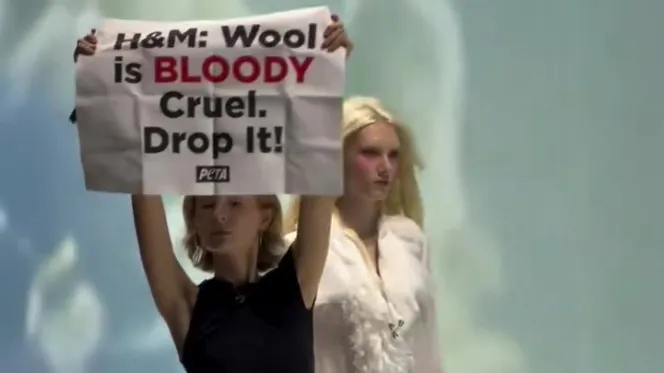
During H&M’s London Fashion Week show on September 17, three PETA activists walked onto the catwalk carrying signs protesting the brand’s use of wool. Their message was blunt: “H&M: Wool is bloody cruel. Drop it!” Security followed the protesters from the runway, and the show continued after the interruptions.
The protest was not exactly a fashion-week surprise. It formed part of a wider PETA campaign targeting H&M Group’s use of wool. Days earlier, activists had disrupted a COS show in New York, another H&M Group brand. The London demonstration was accompanied by supporters outside the venue, including a protest featuring a fake injured sheep.
Who are PETA?
PETA stands for People for the Ethical Treatment of Animals. Founded in 1980, the international animal-rights organisation campaigns against the use of animals in areas including food, clothing, entertainment and scientific experimentation. It uses investigations, public campaigns, lobbying and high-profile protests to promote its position that animals should not be exploited by humans.
And wool is now firmly in its sights.
PETA says investigations into sheep farms have documented animals being kicked, beaten and injured during shearing. The organisation argues that these practices demonstrate why fashion brands should stop using wool altogether. Its latest campaign focuses particularly on farms it says are connected to H&M’s supply chain.
But there is another side to the wool story.
Most domesticated wool-producing sheep have been bred to grow coats that require regular shearing. Without it, some sheep can become overheated or vulnerable to problems such as flystrike. That means shearing itself is not inherently a cruel act. The welfare question is how it is carried out.
Poor handling or rushed shearing can cause pain and injury. Practices such as mulesing, used in some sheep-producing countries to reduce the risk of flystrike, have also become a major animal-welfare controversy.
This is where the debate becomes more complicated than simply wool versus no wool.
H&M says it has animal-welfare requirements for wool. Its policy states that, by the end of 2025, virgin sheep wool used by the group should come from farms certified to the Responsible Wool Standard or a similar credible animal-welfare standard. H&M’s current materials policy also says its animal fibres are sourced from farms certified to established welfare standards.
PETA, however, argues that certification is not enough and wants H&M to eliminate wool completely.
And that leaves fashion consumers with a rather uncomfortable question.
When you buy a wool jumper, are you simply buying a warm, natural fibre, or are you also buying into the conditions under which that fibre was produced?
Three people walking onto a fashion runway cannot answer that question for everyone. But they can make the audience look twice at the clothes hanging in their wardrobe.
And perhaps that is the real power of a fashion protest.
Sometimes, the most interesting thing on the runway is not what the model is wearing.
It is the question being carried behind them.
PETA just stormed H&M’s London Fashion Week runway 💥
— Springers24 🌎 (@springers24) September 19, 2026
Not one, not two, but THREE supporters walked the catwalk holding signs that read “H&M: Wool is BLOODY Cruel. Drop It!”
They’re calling out mulesing and rough shearing in the wool industry. Would you still wear it?…