When Gianni Infantino was elected FIFA president in February 2016, he inherited an organisation still trying to recover from the corruption scandals that brought down Sepp Blatter.
Infantino campaigned on reform, transparency and restoring confidence in football’s governing body. Ten years later, he remains at the centre of FIFA, having overseen the expansion of the men’s World Cup to 48 teams and the 2026 tournament across the United States, Canada and Mexico.
He is now seeking another term in office in March 2027. But the final year of his current mandate has brought a series of controversies involving politics, money, disciplinary decisions and FIFA’s governance.
None of these episodes, on their own, establishes wrongdoing. Together, however, they have created a fresh debate about how FIFA is run and how closely its president should operate with political leaders.
The Peace Prize
The controversy began in December 2025, when FIFA introduced a new FIFA Peace Prize and awarded its first edition to US President Donald Trump during the 2026 World Cup draw in Washington.
Infantino has repeatedly expressed support for Trump. In October 2025, he said Trump deserved the Nobel Peace Prize, while at the World Cup draw he told the US president that he “definitely” deserved FIFA’s new award.
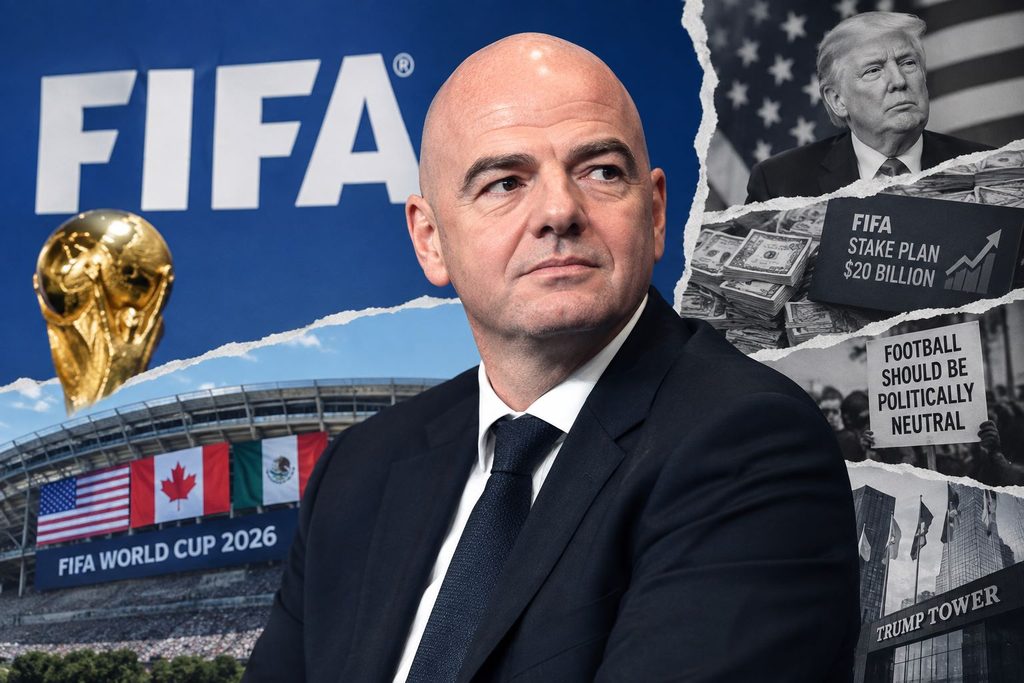
The decision triggered a formal complaint from FairSquare, a London-based human rights organisation, which alleged that Infantino had breached FIFA’s rules requiring football officials to remain politically neutral. The complaint also questioned how the Peace Prize had been created and whether FIFA’s governing council had been properly involved.
The complaint was acknowledged by FIFA’s ethics investigators in December 2025. Fifty Members of the European Parliament subsequently wrote in support of the complaint, urging FIFA’s Ethics Committee to address it. As of September 2026, no public outcome has been announced.
The World Cup stake plan
The next major dispute was financial.
In 2026, FIFA proposed creating a new commercial company called FIFA Forward Enterprise. The proposed entity was valued at about $20 billion, with FIFA considering the sale of a 20% stake to private investors to raise up to $4.2 billion.
Thrive Eternal, an investment group linked to Joshua Kushner, was identified as the leading potential investor.
The proposal immediately faced resistance from major football organisations. UEFA opposed the plan and warned against what it saw as the commercialisation of FIFA’s competitions. CONCACAF and the Asian Football Confederation also objected.
After weeks of pressure, FIFA abandoned the proposal in July.
The controversy has not disappeared with the plan.
In September, UEFA and CONCACAF called for an independent review of FIFA’s finances and proposed distributing at least $10 million to each of FIFA’s 211 member associations from the organisation’s reserves. They argued that FIFA had sufficient financial resources without bringing private investors into the commercial structure.
Infantino has since proposed an independent review of FIFA’s governance and decision-making processes, with the issue expected to be discussed at the FIFA Council’s October meeting.
The Balogun case
Then came one of the most unusual controversies of the 2026 World Cup.
US forward Folarin Balogun was sent off during the United States’ tournament and initially received the standard one-match suspension.
US President Donald Trump later contacted Infantino about the case.
FIFA’s disciplinary committee subsequently suspended Balogun’s ban for a year, allowing him to play in the United States’ next match, while imposing a fine. FIFA maintained that its judicial bodies acted independently.
Belgium challenged Balogun’s eligibility after he was allowed to play against them. FIFA dismissed the challenge as inadmissible, saying Belgium did not have standing to appeal the disciplinary decision. The Belgian federation criticised the lack of transparency around the decision.
The episode nevertheless raised questions about whether political intervention had influenced a football disciplinary matter.
FairSquare later included the Balogun case in an updated ethics complaint submitted to FIFA. More than 100,000 people had added their names to the campaign supporting the complaint.
Other flashpoints
The controversies surrounding Infantino extend beyond the events of 2026.
FIFA has maintained office space in Trump Tower, while Infantino has publicly discussed the possibility of Russia eventually returning to international football.
Saudi Arabia was also awarded the 2034 World Cup after submitting the only bid for the tournament. FIFA’s Congress appointed the country by acclamation in December 2024. FIFA says the bidding process included assessments of infrastructure, sustainability and human rights.
Infantino’s relationship with Qatar also remains part of his legacy.
Ahead of the 2022 World Cup, he defended Qatar against criticism over migrant-worker conditions and began a widely discussed speech by saying: “Today I feel Qatari. Today I feel Arab. Today I feel African. Today I feel gay. Today I feel disabled. Today I feel a migrant worker.”
The comments were criticised by human-rights groups and others who argued that they diverted attention from concerns about migrant workers and labour conditions in Qatar.
There has also been renewed scrutiny of Infantino’s time at UEFA.
In August 2026, The Telegraph reported that a female UEFA employee allegedly involved in a relationship with Infantino received a six-figure departure payment and had MBA fees covered by UEFA. UEFA confirmed the payment and education costs, saying they were consistent with staff rules in place at the time, although those rules were later tightened.
Infantino has strongly denied the relationship allegation, describing it as categorically untrue.
Earlier controversies included questions over private-jet travel during Infantino’s first months as FIFA president and complaints concerning his involvement in FIFA’s governance structures. In the published cases referenced by FairSquare, Infantino was cleared by FIFA’s Ethics Committee in 2016 and 2021.
Where does this leave FIFA?
Infantino remains FIFA president and is preparing to seek another term in March 2027.
But the debate around his leadership has changed.
What began in 2016 with promises to restore FIFA’s credibility has evolved into a broader argument about how much power the president should have, how FIFA makes major commercial decisions and where the line between football and politics should be drawn.
The Peace Prize controversy raised questions about political neutrality. The abandoned FIFA Forward Enterprise plan exposed divisions over FIFA’s financial strategy and decision-making. The Balogun case raised questions about consistency and political influence in disciplinary matters. The Saudi Arabia World Cup award and Infantino’s close relationship with political leaders have added further scrutiny.
There is also now a direct governance response. Infantino has proposed an independent review of FIFA’s decision-making processes, while UEFA, CONCACAF and several national associations continue to call for greater transparency and changes to how major decisions are made.
The central question, therefore, is not simply whether Infantino has delivered on his promises.
It is whether the way FIFA is being governed today matches the standards of transparency and accountability that were promised when he first took office.
That is ultimately a question for FIFA’s member associations, its independent bodies and the evidence they consider. For now, the public record contains a mixture of documented decisions, formal complaints, political disputes and denials. The full judgement on Infantino’s decade at the top of world football is still being written.